
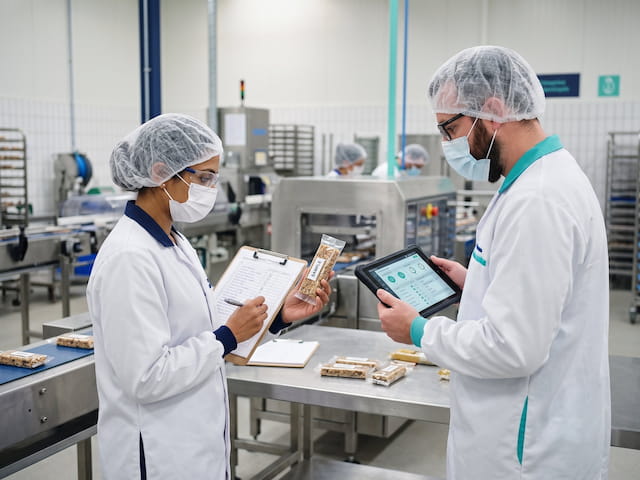
Why these certifications matter
Food producers, manufacturers and suppliers face certification requirements that are specific to their sector and to the markets and customers they serve. A food retailer may require BRCGS or FSSC 22000; an automotive supplier needs IATF 16949; a laboratory needs NABL accreditation; and products entering certain markets need CE marking or faith-based certification such as Halal or Kosher. These are not generic management-system certificates — they are the specific marks that let you onto an approved supplier list or onto a shelf.
What’s included, and who needs it
ABS works across the major industry and food schemes, including HACCP, Halal, Kosher, FSSC 22000, BRCGS, IATF 16949, VDA 6, SMETA, NABL, NABH and CE marking. FSSC 22000, for example, combines the ISO 22000 food-safety management standard with additional food-industry requirements; it applies to organisations of any size across the food industry and helps them identify and manage food-safety hazards more effectively, with recognition that supports access to global markets.
These certifications are for organisations whose customers audit their supply chains: food and beverage producers, contract manufacturers, automotive parts suppliers, testing laboratories and healthcare providers. The relevant scheme is usually dictated by the buyer or the destination market rather than chosen freely.
How ABS approaches these certifications
ABS is a consulting and advisory firm: we prepare you for the certification audit and support you through it, so buyers have a credible basis to trust what your certificate says. Engagements begin with a fixed-price scope tailored to the standard and your operation, with our preparation work delivered on-site where the scheme calls for direct observation of production, or remotely where appropriate, across India and international markets.